
What “Susanna and the Elders” by Tintoretto Is About
Susanna and the Elders Tintoretto is not only a biblical scene. It is also a brilliant lesson in Mannerism, desire, danger and the uneasy position of the viewer. In this painting, beauty becomes a trap, and looking becomes a moral problem.
Wine turns to vinegar. The Renaissance, as a coherent historical period, ends with the fall of Rome in 1527. With the tacit consent of Charles V of Habsburg, the Eternal City is handed over to mercenary Landsknechts. As a result, the old confidence collapses.
The Counter-Reformation triumphs in Southern Europe. A general sense of crisis gives birth to a nervous art of artificial colors and jagged lines. This is Mannerism.
Renaissance ideals now seem naïve and idealistic. Harmony and balance are replaced by compositions overloaded with color, tension and objects. Perfect “antique” figures become elongated, serpentine and unstable.
Poses become tense and exaggerated. Lines grow ornate and jagged. Artists either oversaturate their canvases with eroticism or retreat into asceticism. In other words, art no longer negotiates calmly with heaven. Instead, it speaks through metaphor, grotesque, symbolism and allegory.
Thus, art responds to the deformation of worldviews and social norms.
Tintoretto and the Crisis of the Renaissance
Jacopo Robusti entered the Venetian art scene at a critical moment. His work displays both cold calculation and astonishing mastery. He was even called a “fine-arts dealer”. However, if Titian had lived a little less, Tintoretto might have become the uncontested greatest artist of Venice.
Above his door, Tintoretto placed a famous slogan:
Drawing by Michelangelo, coloring by Titian.
In other words, he declared that he could unite two great schools of his time: the Florentine and the Venetian.
Jean-Paul Sartre later wrote about him in an unfinished monograph:
In 16th-century Italy, faith still burned in the hearts of artists. Their eyes and hands fought atheism. But inside Tintoretto, there was a dizzying emptiness. Art without God: eerie, sinister, gloomy, like a cold wind piercing a wounded heart.
Bernard Berenson, however, saw Tintoretto differently:
Poetry and religion were close to Tintoretto not because of Greco-Roman tradition or church dictates. Rather, he needed them personally. They helped him forget the cruelty of life, supported him in work and consoled him in disappointment.
Therefore, Tintoretto transformed biblical stories into scenes that feel almost borrowed from life. They unfold before our eyes and carry his own personal mood.
Entering “Susanna and the Elders” by Tintoretto
Now let us try to enter the painting.
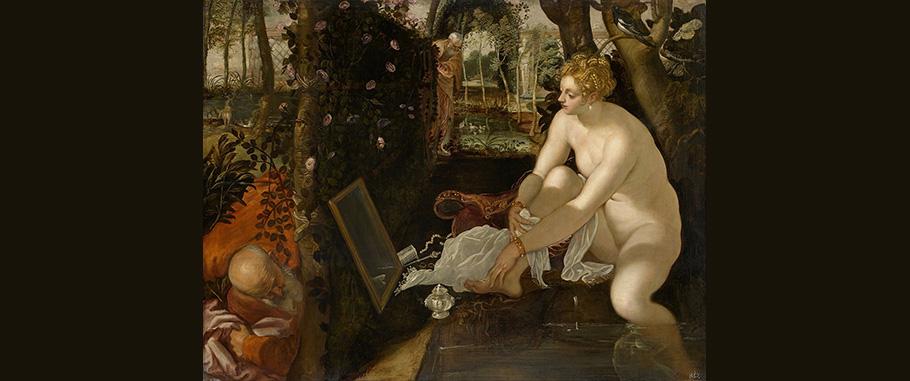
At once, we find ourselves in an awkward position. Yes, we are involuntarily peeping. We cannot take our eyes off this beautiful woman. And Susanna is about to notice us.
Look into the mirror in the painting. Your eyes will meet hers. Perhaps she will smile slyly in return. Tintoretto was a master of such traps.
The biblical story of pious Susanna gave the artist a perfect opportunity. He could show the beauty of the female body through bold drawing, painterly light and shadow, warm and silvery tones, and a broad brushstroke.
This is not yet fully alla prima. Still, it is no longer a slow technique that requires weeks of waiting between layers. Tintoretto uses his signature method known as prestezza: speed, rapidity and agility.
This method has three main stages. First, the artist applies a base color layer. Then he adds an underpainting, usually in white. After that, the final work begins.
Desire, Danger and the Viewer’s Gaze
However, we are not alone in this garden. The bather is being watched by wicked elders. They are unaware of each other’s presence, but their intentions are clear.
In the left corner of the painting, Tintoretto places a goat. This is not a random detail. The goat is a symbol of lust.
Only the garden fence separates Susanna from disaster. Meanwhile, the drama of the composition grows through elongated proportions, tense poses, strange lighting and sharp contrasts of warm and cool tones.
Susanna will reject the advances of the elders. Because of this, she will be slandered. They will accuse her of adultery.
It is no accident that Tintoretto places a gossiping magpie above her. The bird becomes a visual hint. Rumor is already preparing its trap.
Daniel, Justice and the Hidden Hope of the Painting
Yet a savior will appear. A young man named Daniel will expose the elders. He will ask each of them a simple question: under which tree did they see Susanna?
The elders will contradict one another. In other words, they will be caught in their own testimony.
We can see these trees in the depths of the garden. There, through the shadows, the light of justice begins to shine.
Why “Susanna and the Elders” Still Disturbs Us
Susanna and the Elders Tintoretto still feels unsettling because it places the viewer inside the moral conflict. We do not simply observe a biblical story. We become part of the act of looking.
The painting asks uncomfortable questions. Where is the border between admiration and voyeurism? When does beauty become danger? And what happens when society punishes the innocent but protects the powerful?
This is why Tintoretto’s painting remains alive. It is not only about Susanna, the elders and Daniel. It is about vision, desire, shame, accusation and the hope that truth may still be found.
Shall we move on to the next room? We will have plenty to talk about.